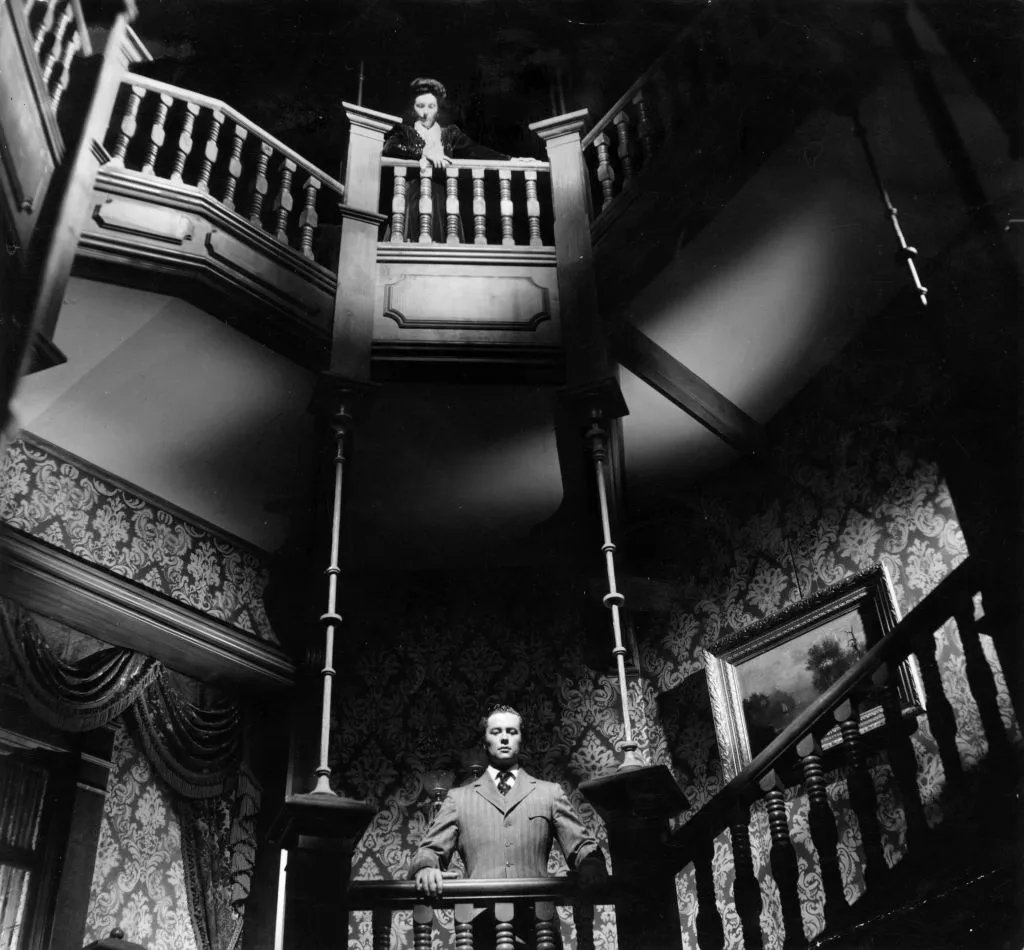
When a startup introduced plans final fall to recreate misplaced footage from Orson Welles’ traditional movie “The Magnificent Ambersons” utilizing generative AI, I used to be skeptical. Greater than that, I used to be baffled why anybody would spend money and time on one thing that appeared assured to outrage cinephiles whereas providing negligible industrial worth.
This week, an in-depth profile by the New Yorker’s Michael Schulman offers extra particulars concerning the challenge. If nothing else, it helps clarify why the startup Fable and its founder Edward Saatchi are pursuing it: It appears to come back from a real love of Welles and his work.
Saatchi (whose father was a founding father of promoting agency Saatchi & Saatchi) recalled a childhood of watching movies in a personal screening room together with his “film mad” mother and father. He stated he first noticed “Ambersons” when he was twelve.
The profile additionally explains why “Ambersons,” whereas a lot much less well-known than Welles’ first movie “Citizen Kane,” stays so tantalizing — Welles himself claimed it was a “significantly better image” than “Kane,” however after a disastrous preview screening, the studio reduce 43 minutes from the movie, added an abrupt and unconvincing comfortable ending, and finally destroyed the excised footage to create space in its vaults.
“To me, that is the holy grail of misplaced cinema,” Saatchi stated. “It simply appeared intuitively that there could be some option to undo what had occurred.”
Saatchi is simply the most recent Welles devotee to dream of recreating the misplaced footage. Actually, Fable is working with filmmaker Brian Rose, who already spent years making an attempt to attain the identical factor with animated scenes based mostly on the film’s script and pictures, and on Welles’ notes. (Rose stated that after he screened the outcomes for family and friends, “plenty of them have been scratching their heads.”)
So whereas Fable is utilizing extra superior know-how — filming scenes in dwell motion, then finally overlaying them with digital recreations of the unique actors and their voices — this challenge is greatest understood as a slicker, better-funded model of Rose’s work. It’s a fan’s try to glimpse Welles’ imaginative and prescient.
Techcrunch occasion
Boston, MA
|
June 23, 2026
Notably, whereas the New Yorker article features a few clips of Rose’s animations, in addition to photographs of Fable’s AI actors, there’s no footage exhibiting the outcomes of Fable’s dwell action-AI hybrid.
By the corporate’s personal admission, there are vital challenges, whether or not that’s fixing apparent blunders like a two-headed model of the actor Joseph Cotten, or the extra subjective process of recreating the complicated fantastic thing about the movie’s cinematography. (Saatchi even described a “happiness” drawback, with the AI tending to make the movie’s ladies look inappropriately comfortable.)
As for whether or not this footage will ever be launched to the general public, Saatchi admitted it was “a complete mistake” to not communicate to Welles’ property earlier than his announcement. Since then, he has reportedly been working to win over each the property and Warner Bros., which owns the rights to the movie. Welles’ daughter Beatrice advised Schulman that whereas she stays “skeptical,” she now believes “they’re going into this challenge with huge respect towards my father and this stunning film.”
The actor and biographer Simon Callow — who’s presently writing the fourth e-book in his multi-volume Welles biography — has additionally agreed to advise the challenge, which he described as a “nice concept.” (Callow is a household good friend of the Saatchis.)
However not everybody has been satisfied. Melissa Galt stated her mom, the actress Anne Baxter, would “not have agreed with that in any respect.”
“It’s not the reality,” Galt stated. “It’s a creation of another person’s reality. But it surely’s not the unique, and he or she was a purist.”
And whereas I’ve change into extra sympathetic to Saatchi’s goals, I nonetheless agree with Galt: At its greatest, this challenge will solely end in a novelty, a dream of what the film may need been.
Actually, Galt’s description of her mom’s place that “as soon as the film was executed, it was executed,” jogged my memory of a latest essay wherein the author Aaron Bady compared AI to the vampires in “Sinners.” Bady argued that on the subject of artwork, each vampires and AI will at all times come up quick, as a result of “what makes artwork doable” is a data of mortality and limitations.
“There is no such thing as a murals with out an ending, with out the purpose at which the work ends (even when the world continues),” he wrote, including, “With out dying, with out loss, and with out the area between my physique and yours, separating my recollections from yours, we can not make artwork or need or feeling.”
In that mild, Saatchi’s insistence that there should be “some option to undo what had occurred” feels, if not outright vampiric, then at the least a bit infantile in its unwillingness to just accept that some losses are everlasting. It could not, maybe, be all that totally different from a startup founder claiming they can make grief obsolete — or a studio govt insisting that “The Magnificent Ambersons” wanted a contented ending.
Thanks for studying! Be a part of our group at Spectator Daily