





Article content
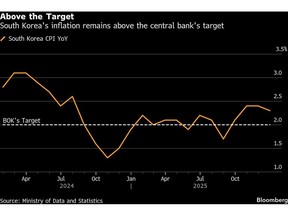
(Bloomberg) — South Korea’s consumer inflation stayed above the central bank’s target for a fourth straight month, even as price growth cooled slightly on slower increases in food and broader living costs.

THIS CONTENT IS RESERVED FOR SUBSCRIBERS ONLY
Subscribe now to read the latest news in your city and across Canada.
- Exclusive articles from Barbara Shecter, Joe O’Connor, Gabriel Friedman, and others.
- Daily content from Financial Times, the world’s leading global business publication.
- Unlimited online access to read articles from Financial Post, National Post and 15 news sites across Canada with one account.
- National Post ePaper, an electronic replica of the print edition to view on any device, share and comment on.
- Daily puzzles, including the New York Times Crossword.
SUBSCRIBE TO UNLOCK MORE ARTICLES
Subscribe now to read the latest news in your city and across Canada.
- Exclusive articles from Barbara Shecter, Joe O’Connor, Gabriel Friedman and others.
- Daily content from Financial Times, the world’s leading global business publication.
- Unlimited online access to read articles from Financial Post, National Post and 15 news sites across Canada with one account.
- National Post ePaper, an electronic replica of the print edition to view on any device, share and comment on.
- Daily puzzles, including the New York Times Crossword.
REGISTER / SIGN IN TO UNLOCK MORE ARTICLES
Create an account or sign in to continue with your reading experience.
- Access articles from across Canada with one account.
- Share your thoughts and join the conversation in the comments.
- Enjoy additional articles per month.
- Get email updates from your favourite authors.
THIS ARTICLE IS FREE TO READ REGISTER TO UNLOCK.
Create an account or sign in to continue with your reading experience.
- Access articles from across Canada with one account
- Share your thoughts and join the conversation in the comments
- Enjoy additional articles per month
- Get email updates from your favourite authors
Sign In or Create an Account
or
Article content
Growth in consumer prices slowed to 2.3% in December from a year earlier, decelerating from a 2.4% pace in November, the Ministry of Data and Statistics said Wednesday. The result was in line with the median forecast of 2.3% in a Bloomberg survey of economists.
Article content
Article content
Article content
Core inflation, which excludes volatile food and energy items, advanced at a 2% pace, matching the 2% clip in November, the data showed. Both headline and core gauges continue to hover around the Bank of Korea’s 2% target.
Article content
By signing up you consent to receive the above newsletter from Postmedia Network Inc.
Article content
The data point to easing price pressures, but the figures are not likely to prompt the BOK to resume its monetary easing cycle when authorities next set policy on Jan. 15. A persistent rally in the property market has raised concerns over growing mortgage debt levels that could lead to financial imbalances, making the central bank reluctant to add stimulus.
Article content
Also, living costs may continue to rise. Authorities warned earlier this month that strength in food prices could help push inflation above the projected path next year even as underlying price pressure remains largely contained.
Article content
In December, food and non-alcoholic beverage prices rose 3.6% from a year earlier, easing from November, while housing and utilities costs increased 1.3%. Prices for food and lodging gained 3%, and transportation costs climbed 3.2%.
Article content
The slowdown was led by easing costs for telecommunication, alcoholic beverages and tobacco products. Policymakers remain wary of upside risks from the weak Korean won, which could feed through to prices for imported goods in a country heavily reliant on overseas supplies of food and energy.
Article content
Article content
Broader consumer-price gains remained modest in the latest month, with education costs rising 1.6% and recreation and culture gaining 1.2%, both slower than the previous month.
Article content
Still, apartment prices in Seoul extended their gains for a 47th straight week as of Dec. 22, according to the Korea Real Estate Board, reinforcing the BOK’s concern that rate cuts could fuel financial imbalances.
Article content
The BOK held its benchmark rate steady at 2.5% in late November while also slightly increasing its growth and inflation outlooks. Authorities also removed a reference in the statement to maintaining a rate-cut stance, prompting some economists to speculate that the easing cycle might have run its course.
Article content
Officials are keeping their options open. The bank said last week that it will keep the door open to further cuts next year, while also increasing vigilance over financial stability risks from foreign-exchange and housing markets.
Article content
What Bloomberg Economics Says…
Article content
“We expect CPI to stay elevated in the near term as a weaker won lifts import costs and keeps underlying pressures firm. That sticky inflation backdrop reinforces our view that the BOK will look past the recent soft patch in factory production and keep the policy rate steady at 2.5%.”
Article content
— Hyosung Kwon, economist
Article content
Click here to read the full report
Article content
Inflation is expected to remain anchored around the target, but the BOK warned in a statement for monetary policy in 2026 that upside pressures could prove stronger than anticipated, citing weakness in the won and a recovery in local consumption.
Article content
Buoyant stock prices and the persistent property market rally have supported consumer sentiment for most of the year, with a gauge of confidence staying well above the neutral level for an eighth straight month in December.
Article content
(Updates with a chart and details in 8th paragraph.)
Article content