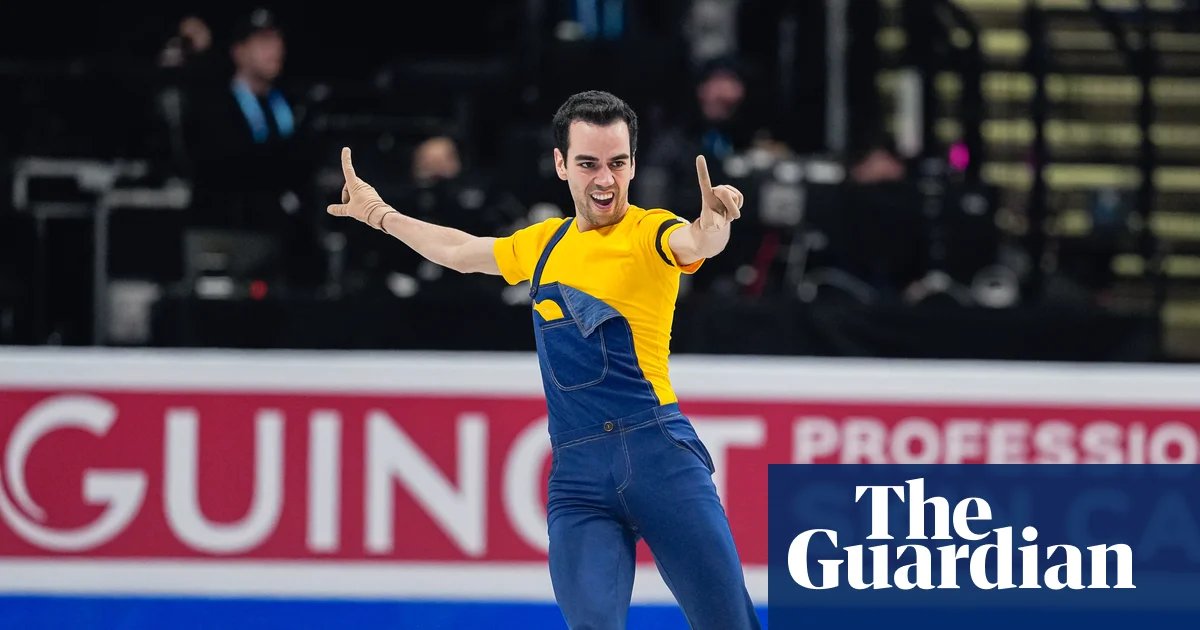
The Spanish determine skater Tomàs-Llorenç Guarino Sabaté faces a last-minute scramble to revamp his Olympic brief program after a copyright dispute blocked him from utilizing music from the Minions franchise simply days earlier than competitors begins on the Milano Cortina Winter Video games.
The six-time Spanish nationwide champion from Barcelona, who is ready to make his Olympic debut within the males’s singles occasion, mentioned he realized late final week that the routine he has carried out all through the 2025-26 season wouldn’t be cleared for Olympic use. Guarino Sabaté mentioned he had submitted the music by way of the Worldwide Skating Union’s really useful rights-clearance course of months in the past and had competed with this system with out problem through the season, together with ultimately month’s European championships in Sheffield.
The ruling means the 26-year-old should now adapt or substitute choreography he has refined for months, a frightening job in a sport the place musical timing and muscle reminiscence are inseparable.
“Discovering this out so near the largest competitors of my life was extremely disappointing,” Guarino Sabaté said in a social media post. “However, I’ll face this problem head-on and do the whole lot I can to make the very best of the state of affairs.”
The routine, constructed round music from the favored animated movie franchise, had change into a signature for the Spanish skater. He recurrently carried out sporting a yellow shirt and blue overalls paying homage to the movie characters, leaning right into a playful, crowd-friendly model he mentioned was designed to indicate that males’s determine skating can steadiness technical issue with humor and character.
Rights to the Minions property are managed by Illumination and mum or dad studio Common Footage. It was not instantly clear which particular licensing hurdle finally blocked Olympic clearance, however music licensing in determine skating has grown more and more labyrinthine in recent times, significantly as the game has shifted towards up to date in style music.
Ultimately yr’s world championships in Boston, the ISU director-general, Colin Smith, described the state of affairs to the Guardian as a structural drawback within the music enterprise reasonably than one thing skating can simply resolve by itself.
“It’s a posh problem, frankly, as a result of the music trade has no widespread clearance platform,” Smith mentioned. “There are a number of buckets of rights, and inside these buckets the clearance course of isn’t completed on a single platform. Monitoring instruments have improved, however the facilitated course of simply isn’t there.”
Smith, who beforehand oversaw Fifa World Cup event operations as chief tournaments and occasions officer and chief working officer from 2015 to 2023, mentioned he had held direct discussions with main rights-holders about constructing one thing extra workable, arguing that the game’s international profile ought to make cooperation engaging.
“I’ve had direct conversations with one of many massive publishing and music firms, and so they absolutely agree it’s an odd state of affairs that there isn’t a facilitated course of – and so they’re decided to assist us discover one,” he mentioned. “What we hear time and time once more is that determine skating is so particular, and so they really need the music heard with determine skating. So the very fact there’s a rights-clearance course of in the way in which must be addressed. It’s a subject we’re addressing, and we’re looking for a rational resolution.”
The controversy additionally matches right into a broader sample throughout the game, the place even elite Olympic athletes have discovered their music decisions topic to late-stage authorized or monetary issues.
The Canadian ice dancers Marie-Jade Lauriault and Romain Le Gac realized late final yr that two Prince songs deliberate for his or her Nineteen Nineties-themed rhythm dance couldn’t be cleared for Olympic use, regardless of being accredited to be used throughout the remainder of the season. The pair had secured their Olympic place with a podium end at Canadian nationals however have been pressured to transform their program for the Video games.
Excessive-profile disputes have surfaced even earlier than that. On the Beijing Olympics in 2022, the American pairs champions Alexa Knierim and Brandon Frazier have been hit with a copyright lawsuit tied to their use of a canopy model of Home of the Rising Solar. The case was later settled privately for an undisclosed sum understood by the Guardian to be round $1.4m (£1.02m), however the episode highlighted the authorized and monetary dangers tied to music choice on the sport’s highest stage. Knierim later described the dispute as casting a “bittersweet” shadow over the efficiency.
The case additionally uncovered how little many athletes understood about music licensing necessities. For many years, skaters largely relied on federations and occasion organizers to handle music use, however the lawsuit underscored how particular person athletes might nonetheless be drawn into copyright disputes. Rights issues have additionally affected how creative sports activities are broadcast and archived, with some competitions unavailable on replay platforms as a result of music licenses don’t lengthen to long-term streaming.
Even outdoors Olympic seasons, clearance prices can derail packages. The Canadian pairs skaters Deanna Stellato-Dudek and Maxime Deschamps mentioned they deserted plans to make use of a canopy of a Phil Collins monitor after being quoted a licensing charge within the tens of 1000’s of {dollars}.
Taken collectively, the instances mirror how music rights – as soon as a secondary consideration in determine skating – have change into a logistical and monetary problem athletes should navigate alongside coaching and competitors.
Smith mentioned skating shouldn’t be alone in dealing with these pressures, and recommended a broader, cross-sport strategy could also be vital, involving Olympic organizers and different music-driven judged disciplines.
“Completely, it’s not simply determine skating,” he mentioned when requested whether or not the ISU might coordinate with sports activities reminiscent of gymnastics, creative swimming and others that face related points. “We’re one of many largest when it comes to the Winter Olympics, and we’re working with the IOC as effectively, along with the music trade, to discover a resolution.”
Smith added that the ISU was pursuing what he known as a “multi-pronged strategy”, together with work with an present platform that handles rights points throughout different sports activities.
“We’re actually looking for a rational, sensible resolution,” he mentioned.
Guarino Sabaté mentioned he adopted required procedures, together with submitting his music by way of the ClicknClear licensing system through the summer time. The corporate has mentioned typically that Olympic members should safe all vital authorizations earlier than utilizing music in competitors, but it surely doesn’t touch upon particular person instances.
The ISU confirmed it’s monitoring Guarino Sabaté’s state of affairs however declined to offer particulars concerning the particular dispute.
“The ISU is conscious of this case,” the governing physique mentioned on Monday in an announcement to the Guardian. “As quickly as now we have extra particulars on this particular case, we’ll share them as applicable. Copyright clearances can characterize a problem for all creative sports activities. Whereas the ISU doesn’t have a contractual relationship with ClicknClear, we proceed to work collaboratively with rights clearance stakeholders to make sure that thrilling performances might be accompanied by stirring music.”
The timing leaves Guarino Sabaté with restricted choices. Skaters usually spend months constructing choreography that matches particular musical phrasing and emotional beats. Switching music days earlier than competitors typically means simplifying components, adjusting step sequences or reverting to older packages.
One potential fallback might contain returning to music he utilized in earlier seasons, although even that carries issues if related artists or tracks are already tied to different packages or require new clearance.
The boys’s singles occasion is scheduled to start on 10 February on the Milano Ice Skating Enviornment, leaving little time for rehearsal below competitors circumstances.
Regardless of the setback, Guarino Sabaté mentioned he intends to compete whatever the remaining music selection, thanking followers for supporting this system all through the season.
“I promise to step on the ice with the whole lot I’ve and ship packages that each you and I might be happy with,” he mentioned.
Thanks for studying! Be part of our group at Spectator Daily