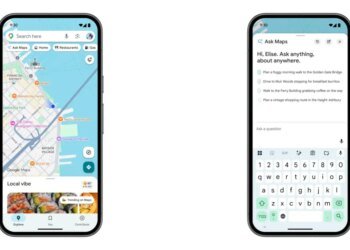
Google Design has an attention-grabbing article this week about “Designing for Transparent Screens” and the work that went into Jetpack Compose Glimmer, Android XR’s design system for Show AI Glasses.
For many who haven’t used sensible glasses with shows earlier than, the very first thing to know is that the “interface doesn’t truly seem on the floor of the lens itself.” Moderately, it’s “projected to a perceived depth of about one meter away.” Moreover, the show space is a sq..
You may get an concept of what to anticipate by “inserting your hand in entrance of you at arm’s size and focusing in your fingers.” As you do that, the “surroundings behind and round your hand goes out of focus,” as seen within the video beneath.
This was a very pivotal realization for our Android XR design crew early on. It seems like a small element, nevertheless it implies that to learn any content material, a consumer has to consciously shift their focus. They’re transferring their gaze from the actual world — say, a good friend’s face, a shocking sundown, or the road forward — to this one-meter focal airplane. It’s not a passive look; it’s an energetic, bodily alternative to interact with the UI, even when only for a millisecond.
Movement on any such show can’t be “distracting or extraneous.” Google’s work on notifications discovered {that a} “typical movement transition of round 500 milliseconds” appeared too shortly:
As a substitute of slowly drawing somebody’s consideration, they might basically “blink” and a notification would immediately be in view.
The implementation Android XR settled on has incoming notification transitions spanning about two seconds throughout which a circle (badged profile avatar) expands right into a capsule.
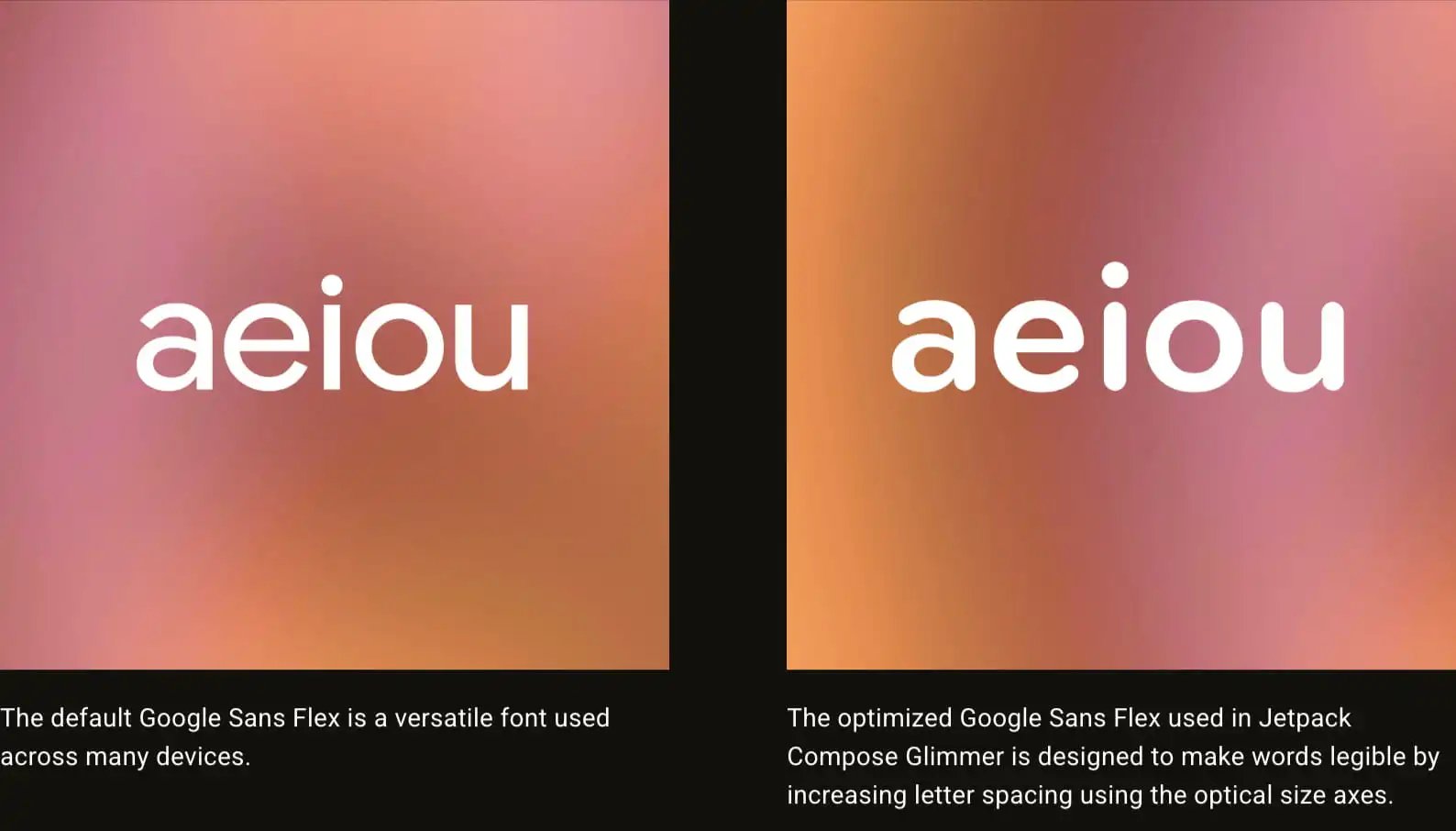
With textual content, Google Sans Flex’s optical dimension axis is used to enhance readability at that one-meter distance:
…letters like a and e have bigger counters (the openings contained in the letter), and the dots on j’s and that i’s are additional away from the letter physique.
Daring typography and elevated letter spacing are additionally advisable, with textual content measured in visible angle (levels) as an alternative of pixels or factors:
Consider it like driving alongside a freeway. You see exit indicators or speed-limit indicators with textual content and graphics printed at a set dimension. However how huge that textual content seems to you adjustments dramatically based mostly in your distance. Distant, it’s tiny; as you get nearer, it grows. That’s visible angle in motion.
These glasses use an additive show that may solely add mild. It can not create black, which seems as 100% clear, with Google equating it to “how a house film projector can’t venture black.”
This proved a problem when Google initially tried to port present Materials parts:
Materials Design, with its tactile metaphors of paper and layers, depends closely on brilliant, opaque surfaces and delicate shadows. On an additive show, these “surfaces” was massive, brilliant blocks of sunshine, creating distracting glare and quickly draining battery life.
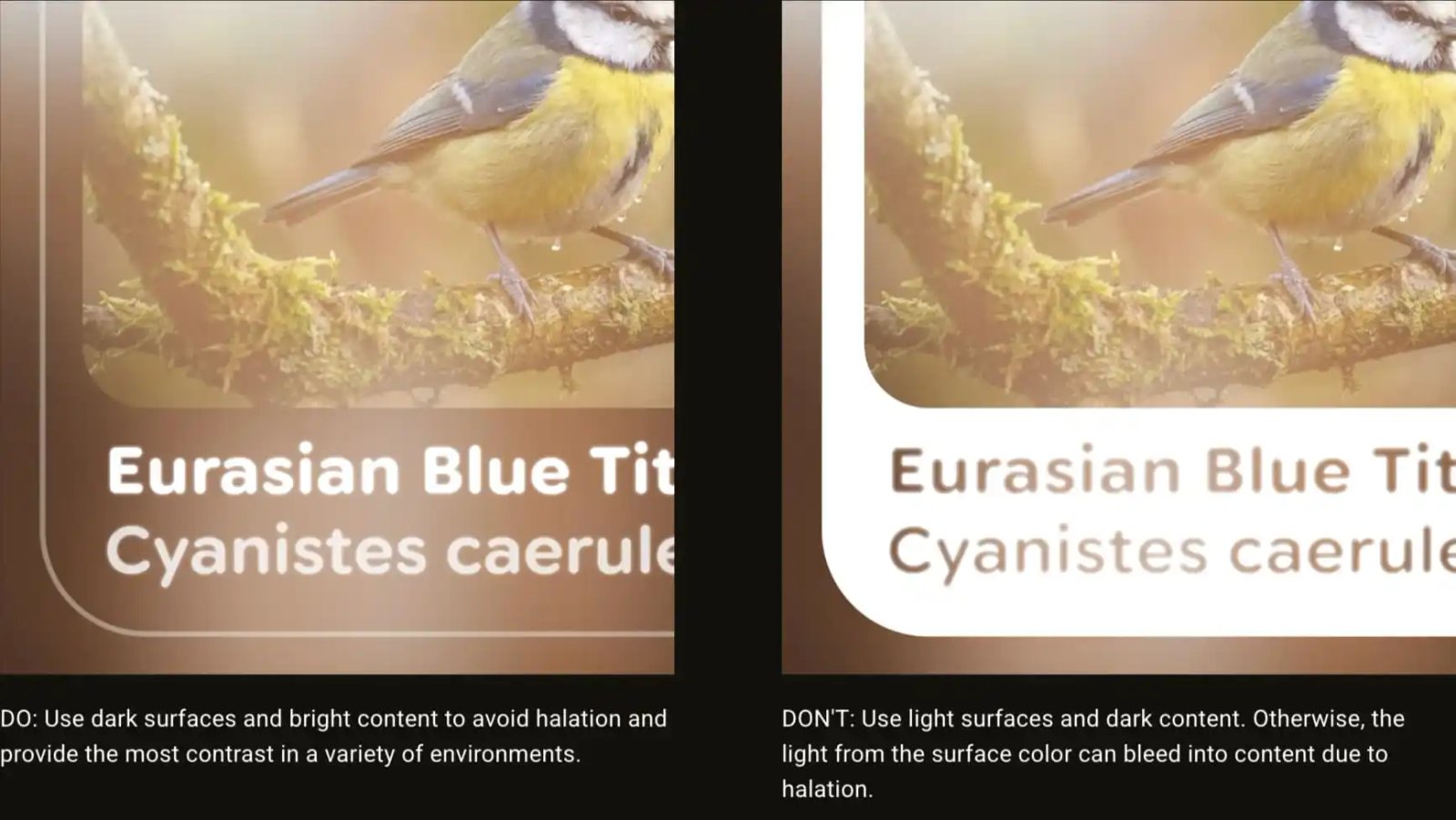
We shortly found one other vital downside: halation. Halation is that impact the place brilliant mild sources bleed into adjoining darker areas, making a blurry, halo-like fringe. On these shows, our brilliant surfaces would bleed into clear content material, making textual content fully illegible.
Google’s answer sees “surfaces use black to offer a legible ‘clear plate’ basis on your content material.” That is paired with a “new depth system that casts darkish, wealthy shadows to convey a way of occlusion and house.”
Moreover, “extremely saturated colours we’d usually use on a telephone merely ‘disappear’ towards the actual world.” As such, Android XR UI is “impartial by default” to “harmonize with the various colours of the actual world.” Colour is used sparingly to attract consideration to buttons and different essential parts.
Surfaces in Glimmer are at all times darkish and the content material itself is at all times brilliant. This high-contrast default is our basis for legibility in most environments.


FTC: We use earnings incomes auto affiliate hyperlinks. More.

Thanks for studying! Be part of our group at Spectator Daily