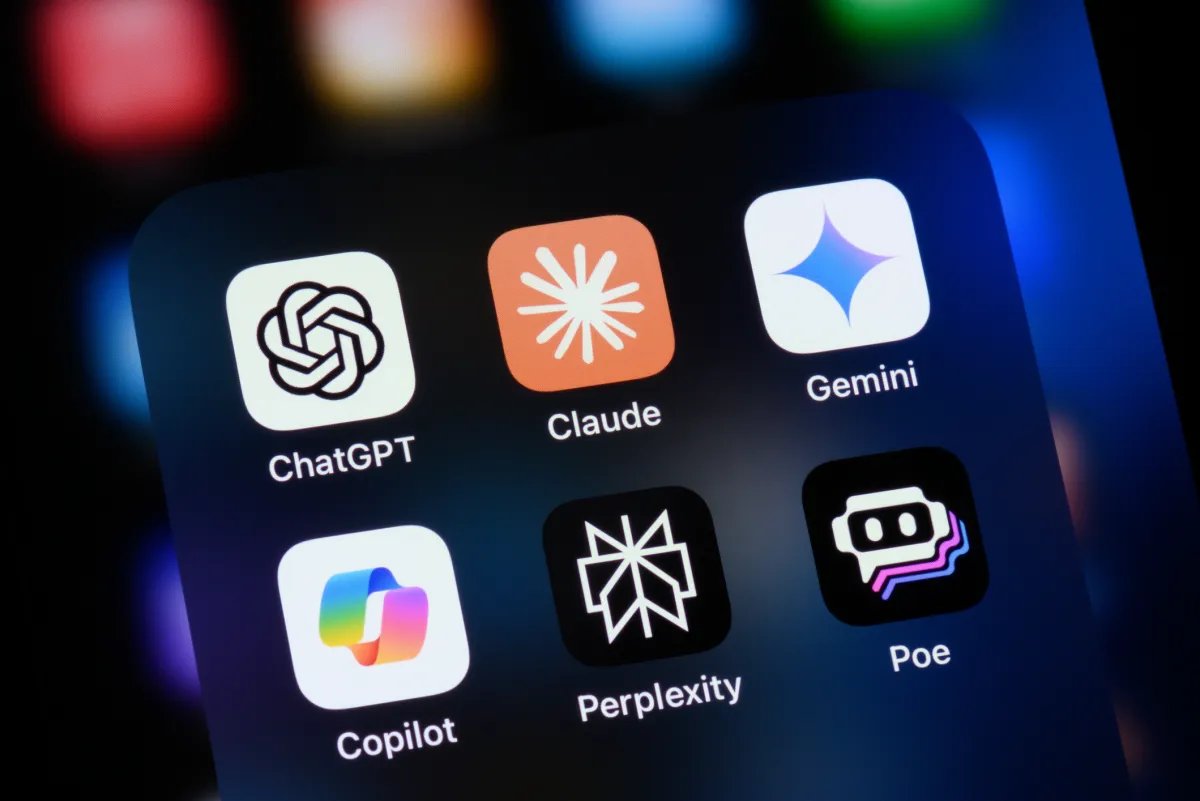
You possibly can chart a 12 months by product launches, or you possibly can measure it within the larger moments that change the way in which we take a look at AI. The AI trade is continually churning out information, like main acquisitions, indie developer successes, public outcry towards sketchy merchandise, and existentially harmful contract negotiations — it’s loads to untangle, so we’re taking a glimpse at the place we’re at and the place we’ve been to date this 12 months.
Anthropic vs. the Pentagon
As soon as enterprise companions, Anthropic CEO Dario Amodei and Protection Secretary Pete Hegseth reached a bitter stalemate in February as they renegotiated the contracts that dictate how the U.S. navy can use Anthropic’s AI instruments.
Anthropic established a tough line towards its AI getting used for mass surveillance of Individuals or to energy autonomous weapons that may assault with out human oversight. In the meantime, the Pentagon has argued that the Division of Protection — which President Donald Trump’s administration calls the Division of Battle — needs to be permitted entry to Anthropic’s fashions for any “lawful use.” Authorities representatives took offense to the concept that the navy needs to be restricted to the principles of a non-public firm, however Amodei stood his floor.
“Anthropic understands that the Division of Battle, not non-public corporations, makes navy choices. We have now by no means raised objections to explicit navy operations nor tried to restrict use of our expertise in an advert hoc method,” Amodei wrote in a statement addressing the scenario. “Nonetheless, in a slender set of circumstances, we consider AI can undermine, quite than defend, democratic values.”
The Pentagon gave Anthropic a deadline to comply with their contract. Lots of of staff at Google and OpenAI signed an open letter urging their respective leaders to respect Amodei’s limits and refuse to budge on problems with autonomous weapons or home surveillance.
The deadline handed with out Anthropic agreeing to the Pentagon’s calls for. Trump directed federal companies to section out their use of Anthropic instruments over a six-month transition interval and referred to as the AI firm, which is valued at $380 billion, a “radical left, woke firm” in an all-caps social media put up. The Pentagon then moved to declare Anthropic a “supply-chain danger,” a designation that’s normally reserved for international adversaries and prevents any firm that works with Anthropic from doing enterprise with the U.S. navy. (Anthropic has since sued to problem the designation.)
Anthropic rival OpenAI then swooped in and introduced that it had reached an settlement permitting its personal fashions to be deployed in categorized conditions. It was a shock to the tech group, since reports had indicated that OpenAI would keep on with Anthropic’s crimson traces governing use of AI for the navy.
Techcrunch occasion
San Francisco, CA
|
October 13-15, 2026
Public sentiment would point out that folks discovered OpenAI’s transfer fishy — on the day after OpenAI introduced its deal, ChatGPT uninstalls jumped 295% day-over-day and Anthropic’s Claude shot to No. 1 within the App Retailer. OpenAI {hardware} govt Caitlin Kalinowski give up in response to the deal, saying that it was “rushed with out the guardrails outlined.”
OpenAI instructed TechCrunch that it believes its settlement “makes clear [its] redlines: no autonomous weapons and no autonomous surveillance.”
As this saga performs out, it’ll have important implications for the way forward for how AI is deployed at struggle, doubtlessly altering the course of historical past — you already know, no huge deal …
“Vibe-coded” app OpenClaw accelerates the flip to agentic AI
February was the month of OpenClaw, and its impression continues to reverberate. In fast succession, the vibe-coded AI assistant app went viral, spawned a bunch of spinoff corporations, suffered from privateness snafus, after which acquired acquired by OpenAI. Even one of many corporations constructed on OpenClaw, a Reddit-clone for AI brokers referred to as Moltbook, was lately acquired by Meta. This crustacean-themed ecosystem whipped Silicon Valley right into a downright frenzy.
Created by Peter Steinberger — who has since joined OpenAI — OpenClaw is a wrapper for AI fashions like Claude, ChatGPT, Google’s Gemini, or xAI’s Grok. What units it aside is that it permits individuals to speak with AI brokers in pure language through the preferred chat apps, like iMessage, Discord, Slack, or WhatsApp. There’s additionally a public market the place individuals can code and add “abilities” for individuals so as to add to their AI brokers, making it attainable to automate principally something that may be performed on a pc.
If that appears too good to be true, it’s as a result of it type of is. To ensure that an AI agent to be efficient as a private assistant, it must have entry to your e mail, bank card numbers, textual content messages, laptop information, and many others. If it have been to be hacked, loads might go fallacious, and sadly, there’s no solution to totally safe these brokers towards prompt-injection assaults.
“It’s simply an agent sitting with a bunch of credentials on a field related to every part — your e mail, your messaging platform, every part you utilize,” Ian Ahl, CTO at Permiso Safety, instructed TechCrunch. “So what which means is, whenever you get an e mail, and possibly anyone is ready to put a little bit immediate injection method in there to take an motion, [and] that agent sitting in your field with entry to every part you’ve given it to can now take that motion.”
One AI safety researcher at Meta mentioned that OpenClaw ran amok on her inbox, deleting all of her emails regardless of repeated calls to cease. “I needed to RUN to my Mac mini like I used to be defusing a bomb” to bodily unplug the system, she wrote in a now-viral post on X, which included photos of the ignored cease prompts as receipts.
Regardless of the safety dangers, the expertise piqued OpenAI’s curiosity sufficient for an acqui-hire.
Different instruments constructed on OpenClaw, together with Moltbook — a Reddit-like “social community” the place AI brokers can talk with each other — ended up turning into extra viral than OpenClaw itself.
In a single occasion, a post went viral through which an AI agent gave the impression to be encouraging its fellow brokers to develop their very own secret, end-to-end-encrypted language the place they might manage amongst themselves with out people realizing.
However researchers quickly revealed that the vibe-coded Moltbook wasn’t very safe, which means that it was very straightforward for human customers to pose as AIs to make posts that may set off viral social hysteria.
Once more, despite the fact that the dialogue round Moltbook was extra grounded in panic than actuality, Meta noticed one thing within the app and introduced that Moltbook and its creators, Matt Schlicht and Ben Parr, would be a part of Meta Superintelligence Labs.
It appears unusual that Meta would purchase a social community the place the entire customers are bots. Whereas Meta hasn’t revealed a lot concerning the acquisition, we theorize that proudly owning Moltbook is extra about having access to the expertise behind it, who’re captivated with experimenting with AI agent ecosystems. CEO Mark Zuckerberg has said it himself: He thinks that at some point, each enterprise may have a enterprise AI.
As we watch the hubbub round OpenClaw, Moltbook, and NanoClaw play out, it appears as if those that predicted an agentic AI future could also be on to one thing, at the least for now.
Chip shortages, {hardware} drama, and knowledge middle calls for escalate
The cruel calls for of the AI trade — which require computing energy and knowledge facilities in unprecedented volumes — are reaching some extent the place the typical shopper has no selection however to concentrate. Now it might not even be attainable for the trade to fulfill the astronomical demands for memory chips, and customers are already seeing the costs of their telephones, laptops, vehicles, and different {hardware} improve.
Thus far, analysts from IDC and Counterpoint have predicted that smartphone shipments, for instance, will plummet about 12% to 13% this 12 months; Apple has already raised MacBook Professional costs by as much as $400.
Google, Amazon, Meta, and Microsoft are planning to spend as much as a mixed $650 billion on knowledge facilities alone this 12 months, which is an estimated 60% improve from final 12 months.
If the chip scarcity doesn’t hit you in your pockets, it would hit your group at massive. Within the U.S. alone, practically 3,000 new data centers are beneath development, including to the 4,000 already working within the nation. The necessity for laborers to construct these knowledge facilities is important sufficient that “man camps” have sprung up in Nevada and Texas, trying to lure employees with the promise of golf simulator recreation rooms and steaks grilled on-demand.
Not solely does knowledge middle development have a long-term impression on the setting, but it surely additionally creates health hazards for close by residents, polluting the air and impacting the protection of close by water sources.
All of the whereas, one of the vital useful {hardware} and chip builders, Nvidia, is reshaping its relationship to main AI corporations like OpenAI and Anthropic. Nvidia has been an ongoing backer of those corporations, sparking considerations across the circularity of the AI trade and the way a lot of these eye-popping valuations are based mostly on recursive offers with one another. Final 12 months, for instance, Nvidia invested $100 billion in OpenAI inventory, and OpenAI then mentioned it could purchase $100 billion of Nvidia chips.
It was stunning, then, when Nvidia CEO Jensen Huang mentioned that his firm would cease investing in OpenAI and Anthropic. He mentioned that it is because the businesses plan to go public later this 12 months, although that logic doesn’t fairly make sense, since traders usually funnel in extra money pre-IPO to extract as a lot worth as attainable.
Thanks for studying! Be part of our group at Spectator Daily